



Words R Us
- Tagalog (tgl)
The national language of the Philippines in known as Filipino
(Wikang Filipino). It is a standard register of Tagalog, and is
defined by the Commission on the Filipino Language (Komisyon
sa Wikang Filipino) as "the native language, spoken and written,
in Metro Manila, the National Capital Region, and in other urban
centers of the archipelago." Filipino is also influenced by other
Philippine languages.
Tagalog is a is an Austronesian language spoken as a first
language by the ethnic Tagalog people, who make up a quarter of
the population of the Philippines, and as a second language by
the majority. It is spoken particularly in Manila, central and
southern parts of Luzon, and also on the islands of Lubang,
Marinduque, and the northern and eastern parts of Mindoro.
Tagalog speakers can also be found in many other countries,
including Canada, Guam, Midway Islands, Saudi Arabia, the UAE,
UK and USA. Its standardized form, officially named Filipino, is
the national language of the Philippines, and is one of two official
languages, alongside English.
According to the 2010 census, there are about 22.5 million
speakers of Tagalog in the Philippines. According to survey
conducted by the US Census Bureau, there were about 1.6
million Tagalog speakers in the USA in 2013.
The name Tagalog derives from tagá-ílog, which means "resident
beside the river". Little is known of the history of the language
before the arrival of the Spanish in the Philippines during the 16th
century as no eariler written materials have been found.
There are four main dialects: Northern (exemplified by the Bulacan
dialect), Central (including Manila), Southern (exemplified by
Batangas), and Marinduque.
Sources: Wikipedia
https://omniglot.com/writing/tagalog.htm
Tagalog is a is an Austronesian language spoken as a first language by the ethnic Tagalog people, who make up a quarter of the population of the Philippines, and as a second language by the majority. It is spoken particularly in Manila, central and southern parts of Luzon, and also on the islands of Lubang, Marinduque, and the northern and eastern parts of Mindoro. Tagalog speakers can also be found in many other countries, including Canada, Guam, Midway Islands, Saudi Arabia, the UAE, UK and USA. Its standardized form, officially named Filipino, is the national language of the Philippines, and is one of two official languages, alongside English.
According to the 2010 census, there are about 22.5 million speakers of Tagalog in the Philippines. According to survey conducted by the US Census Bureau, there were about 1.6 million Tagalog speakers in the USA in 2013.
The name Tagalog derives from tagá-ílog, which means "resident beside the river". Little is known of the history of the language before the arrival of the Spanish in the Philippines during the 16th century as no eariler written materials have been found.
There are four main dialects: Northern (exemplified by the Bulacan dialect), Central (including Manila), Southern (exemplified by Batangas), and Marinduque.
https://omniglot.com/writing/tagalog.htm

Language Learning Lessons
are available for Tagalog.
Search English ~ Tagalog
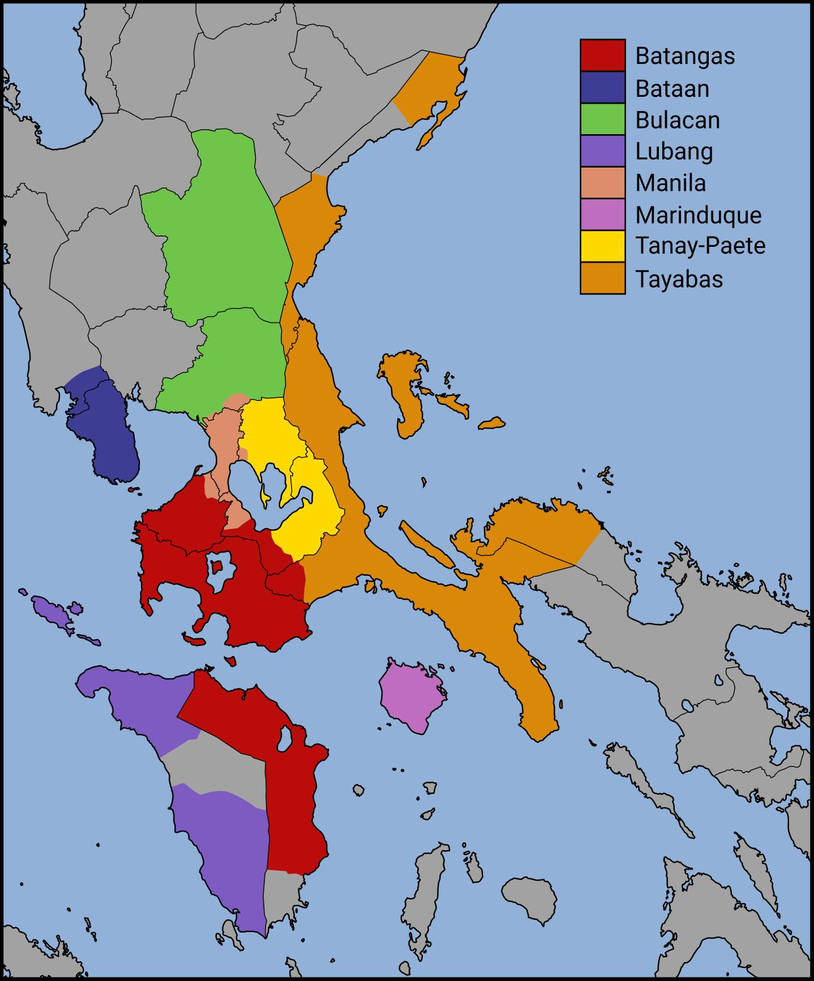
Tagalog Language Map by dialects